Quartz is meant to be extremely configurable, even if you don’t know any coding. Most of the configuration you should need can be done by just editing quartz.config.yaml.
Tip
If you edit quartz.config.yaml using a text-editor with YAML language support like VSCode, it will warn you when you’ve made an error in your configuration, helping you avoid configuration mistakes!
The configuration of Quartz can be broken down into two main parts:
quartz.config.yaml
configuration: pageTitle: "My Site" # ... general configurationplugins: - source: github:quartz-community/some-plugin enabled: true # ... plugin entries
General Configuration
This part of the configuration concerns anything that can affect the whole site. The following is a list breaking down all the things you can configure:
pageTitle: title of the site. This is also used when generating the RSS Feed for your site.
pageTitleSuffix: a string added to the end of the page title. This only applies to the browser tab title, not the title shown at the top of the page.
enableSPA: whether to enable SPA Routing on your site.
enablePopovers: whether to enable popover previews on your site.
analytics: what to use for analytics on your site. Values can be
null: don’t use analytics;
{ provider: 'google', tagId: '<your-google-tag>' }: use Google Analytics;
{ provider: 'plausible' } (managed) or { provider: 'plausible', host: 'https://<your-plausible-host>' } (self-hosted, make sure to include the https:// protocol prefix): use Plausible;
{ provider: 'umami', host: '<your-umami-host>', websiteId: '<your-umami-website-id>' }: use Umami;
baseUrl: this is used for sitemaps and RSS feeds that require an absolute URL to know where the canonical ‘home’ of your site lives. This is normally the deployed URL of your site (e.g. quartz.jzhao.xyz for this site). Do not include the protocol (i.e. https://) or any leading or trailing slashes.
You will be prompted to set this during `npx quartz create`. The CLI automatically strips any https:// or http:// protocol prefixes and trailing slashes for you.
This should also include the subpath if you are hosting on GitHub pages without a custom domain. For example, if my repository is jackyzha0/quartz, GitHub pages would deploy to https://jackyzha0.github.io/quartz and the baseUrl would be jackyzha0.github.io/quartz.
Note that Quartz 5 will avoid using this as much as possible and use relative URLs whenever it can to make sure your site works no matter where you end up actually deploying it.
ignorePatterns: a list of glob patterns that Quartz should ignore and not search through when looking for files inside the content folder. See private pages for more details.
defaultDateType: whether to use created, modified, or published as the default date to display on pages and page listings.
theme: configure how the site looks.
cdnCaching: if true (default), use Google CDN to cache the fonts. This will generally be faster. Disable (false) this if you want Quartz to download the fonts to be self-contained.
typography: what fonts to use. Any font available on Google Fonts works here.
title: font for the title of the site (optional, same as header by default)
Plugins are categorized by their type (transformer, filter, emitter, pageType) based on their manifest. The order field controls execution order within each category.
Note
For advanced TS override of plugin configuration, you can modify quartz.ts:
quartz.ts
import { loadQuartzConfig, loadQuartzLayout } from "./quartz/plugins/loader/config-loader"const config = await loadQuartzConfig({ // override any configuration field here})export default configexport const layout = await loadQuartzLayout()
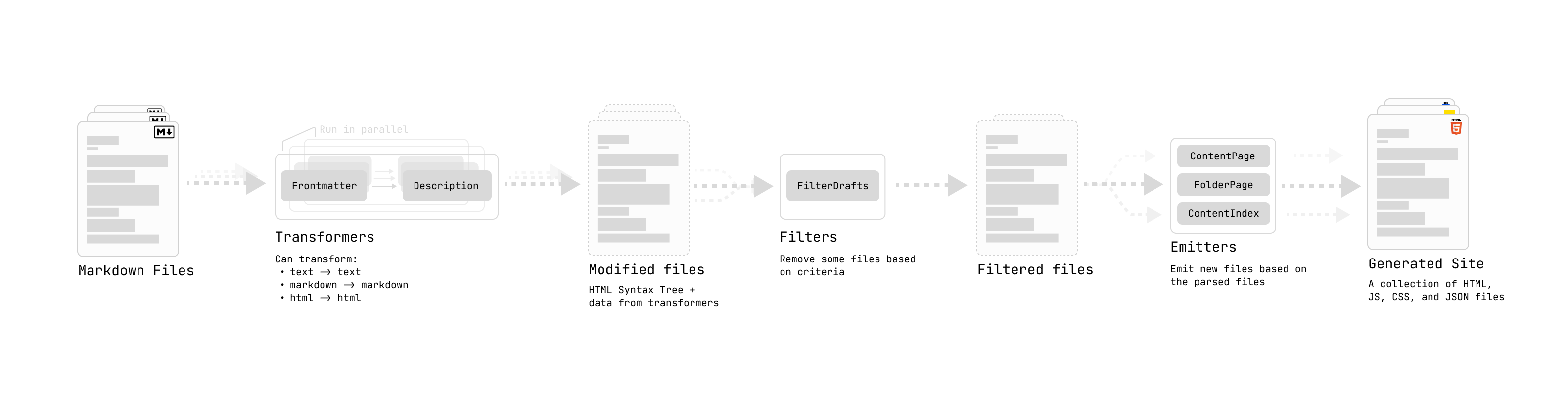
Transformersmap over content (e.g. parsing frontmatter, generating a description)
Emittersreduce over content (e.g. creating an RSS feed or pages that list all files with a specific tag)
Page Types define how different types of pages are rendered (content pages, folder listings, tag listings). Each page type can use a different page frame to control its overall HTML structure.
The layout.byPageType section in quartz.config.yaml can also set a template field to override the page frame for a specific page type:
quartz.config.yaml
layout:
  byPageType:
    canvas:
      template: minimal # Override the page frame for canvas pages
See layout for details on available frames and how frame resolution works.
Internal vs External Plugins
Quartz distinguishes between internal plugins that are bundled with Quartz and community plugins that are installed separately.
In quartz.config.yaml, community plugins are referenced by their GitHub source:
Internal plugins (like FrontMatter) are bundled with Quartz. Community plugins are installed separately and referenced by their github:org/repo source.
Community Plugins
To install a community plugin, you can use the following command:
The string form github:user/repo#branch and the object form { repo, ref } are equivalent ways to specify a branch. Use the object form when you also need subdir or name, or when you prefer a more readable configuration.
Usage
You can customize the behaviour of Quartz by adding, removing and reordering plugins in quartz.config.yaml. Each plugin entry specifies its source, whether it’s enabled, execution order, and any options:
For advanced options that require JavaScript (e.g. callback functions), use the TS override in quartz.ts. See the plugin-specific documentation for details.
You can see a list of all plugins and their configuration options here.